
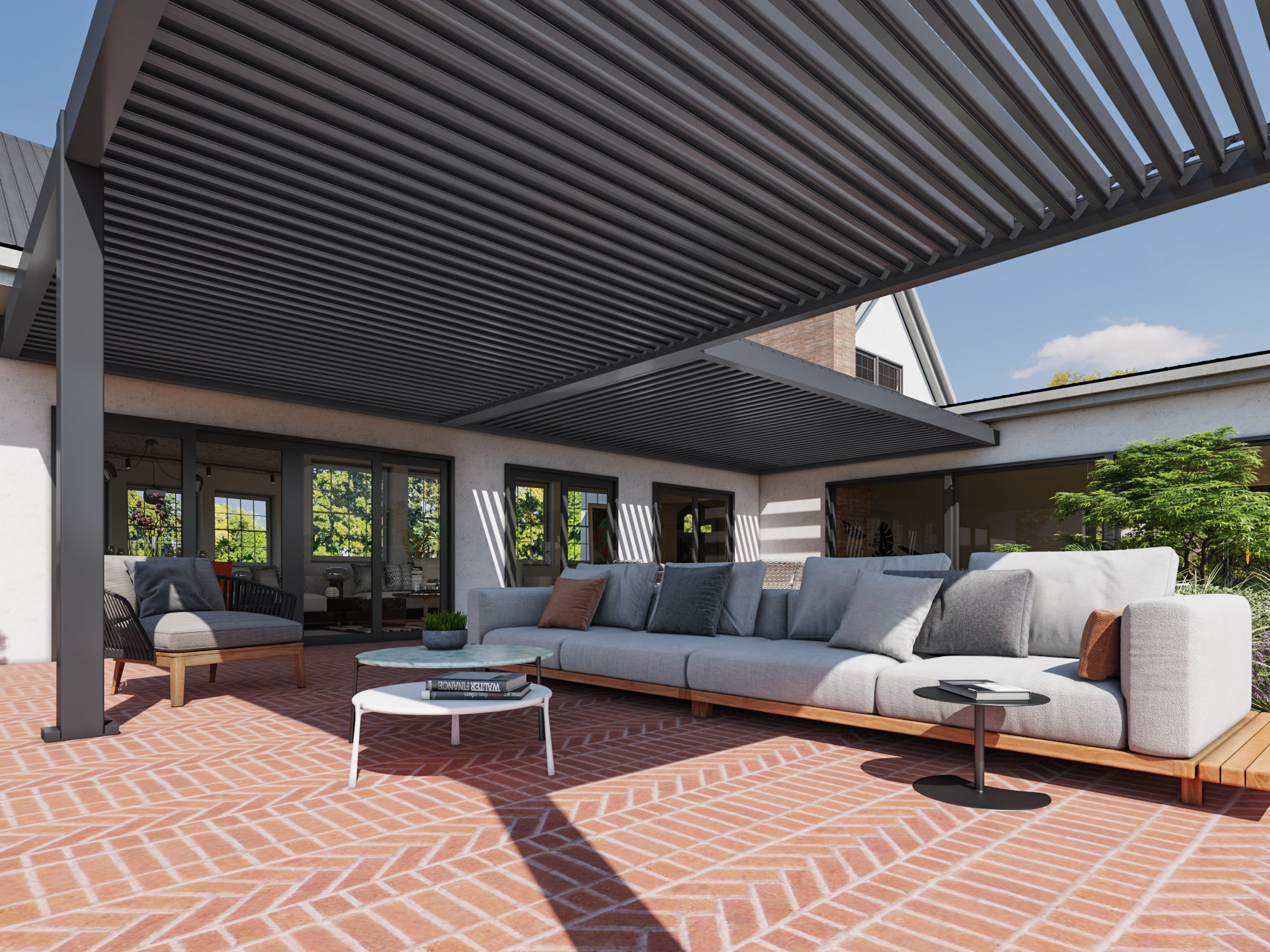

Louvred Pergolas vs. Traditional Pergolas
You've decided to make better use of your outdoor space, but now comes the difficult part: choosing the right pergola. Should you opt for the timeless appeal of a traditional pergola, or invest in a louvre roof system that offers greater flexibility and control? Both can transform the look and feel of your space, but they are built with different priorities in mind. This louvre pergola vs standard pergola comparison looks at the key differences between the two, helping you choose a pergola that not only suits your home, but also delivers the quality, performance, and lasting value you expect from your outdoor space. Louvre pergola vs standard pergola Below, we compare the two across six key areas: light control, weather protection, materials, aesthetics, smart accessories, and cost. Light control and ventilation Start with light, since it's usually the first thing people notice. A traditional pergola works with fixed rafters or beams, spaced to let a certain amount of dappled light filter through. Once it's built, the level of shade remains largely the same, regardless of the time of day or changing weather conditions. Some homeowners like the simplicity of that. Others find, a few summers in, that a fixed structure eventually feels like it's working against the weather. A louvre roof offers greater flexibility. Its individually rotating aluminium blades can be opened to let in more sunlight, angled to provide filtered shade, or closed to create a more sheltered space. That allows you to adjust the amount of light and airflow throughout the day, rather than relying on a fixed level of shade. If you want an outdoor space that can adapt to different conditions, a louvre roof gives you greater control over how the space feels and functions. Weather protection A traditional pergola is generally open by design, offering shade but limited protection from rain. When an unexpected downpour arrives, the space may no longer be practical for outdoor dining or entertaining. A louvre roof provides greater protection by allowing the blades to close and create a more sheltered environment. When properly designed and installed, the roof can help keep rain out, allowing you to continue using the space when the weather changes. If you're comparing a louvre roof vs pergola for weather protection, the added coverage of a louvre roof can make it a more versatile option for using your outdoor area in a wider range of conditions. Materials and durability Materials are where the pergola vs louvres comparison becomes most practical, since each option comes with different durability and maintenance requirements. Traditional pergolas are often built from timber, which offers a warm, natural appearance that complements garden settings. However, timber requires regular maintenance to help protect it from moisture, heat, and general weather exposure. Without proper care, it can become more vulnerable to issues such as warping, cracking, or rot over time. Louvre roof systems, by comparison, are typically constructed using materials such as powder-coated aluminium, which offers a durable and low-maintenance alternative to timber. Aluminium is resistant to corrosion and does not require the same level of ongoing treatment as natural wood. If you prefer a modern structure that requires less upkeep while offering long-term durability, a louvre roof may be the more practical option. Aesthetics If you're comparing a louvre roof vs pergola for aesthetics, the right choice will largely depend on your home's architectural style. Traditional pergolas have a natural charm that works well in established gardens, particularly around heritage homes or properties with a cottage-style aesthetic. Louvre pergolas offer a more contemporary look, with clean lines and a streamlined architectural profile that complements modern homes and newer builds. Accessory and smart home integration The right accessories can make your outdoor space more comfortable and practical throughout the year. With a traditional pergola, adding features such as heaters and lighting may require separate fixtures or additional installation. A louvre pergola offers greater integration, with features such as heating, lighting, privacy screens, and smart controls designed to work alongside the structure. Depending on the system you choose, you can adjust these features to suit how you use the space, whether you're relaxing with family, enjoying a quiet evening outdoors, or creating a comfortable entertaining space. If you want an outdoor space that feels as convenient and connected as the rest of your home, a louvre pergola gives you more flexibility to create the experience you want. Upfront cost vs long-term value Cost is the final factor to consider, but also one of the clearest differences in the louvres vs traditional pergola comparison. Traditional pergolas tend to have a lower upfront cost, as their simpler design and fewer components make them less expensive to build and install. If you want a straightforward garden feature on a modest budget, this can make a traditional pergola an appealing option. A louvre pergola typically requires a higher initial investment, particularly with features such as aluminium construction, motorisation, and smart controls. However, you also gain greater weather protection, year-round usability, low maintenance, and the flexibility to adjust the space to suit changing conditions. If keeping upfront costs low is your priority, a traditional pergola may be the better fit. But if you want an outdoor space that offers greater flexibility, comfort, and usability throughout the year, a louvre pergola can provide greater value over time. Ready for a louvre roof? Build with Aluvers If the comparison above has you leaning towards a louvre system, our Aluvers team can help you explore the right solution for your home and outdoor space. We design, build, and install architectural louvred pergolas across Melbourne, with a range of systems to suit different spaces and requirements, from the minimalist, manually operated Ibiza to the motorised Santorini and the premium Amalfi system with smart controls and integrated accessories. Every system we install is designed for long-term performance in Melbourne's demanding conditions. That's why we use premium aluminium and steel, selecting materials that are built to provide lasting durability and reliable performance. We take the same considered approach when it comes to the installation itself. Every project starts with a consultation at our Dandenong showroom or on-site, where we take the time to understand your home, your space, and how you want to use it. Ready to explore your options? Visit our Dandenong showroom or speak with our team about the right louvre system for your space.
Learn more
How a Louvre Roof System Increases Your Property Value
At Aluvers, many homeowners come to us because they're tired of having an outdoor space they can't fully enjoy. The patio is there, the furniture is in place, and the space has plenty of potential, but Melbourne's unpredictable weather can make it difficult to use consistently year-round. That's exactly what our louvres are built to solve. Every system we design turns that outdoor space into something homeowners can actually use throughout the day, regardless of the weather. But beyond creating a more functional living area, installing a louvre roof system also turns out to add more value to their property. How does that work? Let's take a closer look at how a louvre roof system increases your property value. How a louvre roof system increases your property value A louvre roof value comes from what it adds to your home: a space that's more usable, more considered in its design, and built to perform for years to come. Make more of the space you already have When you think about how to improve the value of your home, you might picture renovations: a new kitchen, an extra bedroom, or a fresh interior makeover. A renovation to improve the value of your house is a valid option. But sometimes, all you need is combining thoughtful landscaping to improve your home value with a well-designed louvre roof that can adapt to different parts of your lifestyle, without changing the size of your house. With the right setup, the same space can become somewhere to enjoy a quiet morning coffee, have dinner with the family, host friends, or spend time outdoors on the weekend. For you, that means getting more out of the space you already have. And when it comes time to sell, that versatility can add to the overall value of your house, as buyers don't just consider how large the house is, but also how well each part of the house can be used. Enhance your house's architectural appeal A louvre roof adds real value when it's designed to work in harmony with your home's architecture — as a natural extension of the house, not just something built on top of it. When it's done this way, the value it adds extends to the whole property. This matters more than just at resale. If your outdoor space is visible from the kitchen or living room, its design becomes part of what you see and live with daily. When your louvre roof is designed like a real part of the home, that value isn't something you save for resale — it's something you experience all year round. And when that time does come, it counts even more. Buyers usually decide how they feel about a home in the first few minutes of walking through it, taking in the property as a whole rather than part by part. A well-integrated louvre roof strengthens that first impression, and that's part of what buyers see as the value of your property. Protect your outdoor investment At Aluvers, we provide our clients with adjustable roof systems that give greater control over how much exposure their outdoor space receives. When the weather turns harsh, the blades can be closed to provide a layer of protection for the furniture and features underneath. On milder days, the roof can be opened to enjoy the space without keeping everything permanently covered. This can help your outdoor investment maintain its appearance and condition for longer. Furniture is less exposed to the elements, finishes can stay looking better, and the space may require less ongoing maintenance and replacement over time. For you, that means getting more value from the investment you've already made in your outdoor area. And when it comes time to sell, that can be another factor that helps potential buyers see the outdoor area as a worthwhile feature of the property. How to get the most value from your louvre roof system If you're investing in a louvre roof system to increase property value, not every system will deliver the same result. The quality of the materials, how well the design fits your home, how it's built around the way you actually live, and the engineering behind it all are what determine the value and long-term performance of your investment. Quality materials that deliver lasting value At Aluvers, we only use premium aluminium and steel, engineered to hold up against Melbourne's harshest conditions because we understand what a louvre roof needs to do: perform reliably, year after year, not just look good on installation day. If you use cheap materials, they might get you through a season or two, but they'll wear down fast and demand constant upkeep. And by the time you're ready to sell, that louvre roof could already be visibly corroded and worn — adding nothing to your property's value, even becoming something buyers see as a cost, not a feature. If long-term value is what you're looking for, choosing quality materials from the start is an investment worth making. Create a louvre roof designed around your home Even a high-quality louvre roof can feel like an afterthought if the design doesn't suit the home around it. If you build a louvre with Aluvers, our team takes the time to understand your home properly — how it's built, how the light moves through the day, how the space will actually be lived in. We don't work off a standard template, and we never will. Every louvre solution is designed, engineered, and built around your specific home, your site, and your vision, not bought off a shelf and adjusted to fit. Build for comfort, convenience, and everyday use Before deciding what to include in your louvre roof, think about how you want to use the space, so the design can support the way you actually live. It's a question we ask every client at Aluvers because the right accessories only make sense once we understand your lifestyle first. That's why we offer ceiling fans for warm summer days, integrated heaters to extend your evenings into cooler months, and sliding glass doors or zipped blinds to fully enclose the space when the weather turns. Each one is chosen to work as part of the system so the space performs for you in every season. Choose a team who understands the details No matter how good a louvre roof is, it can still fail if the people installing it don't genuinely understand the engineering behind it. That's why it matters to work with a team who truly understands the details, not just an installer. At Aluvers, our installation process is built around exactly that. We're not just making sure your vision comes to life — we're making sure it actually works, with every technical detail handled properly behind the scenes: structural integrity, wind load certification, documentation, council approvals, and precise installation. Bring your vision to life with Aluvers You've learned how a louvre roof system increases your property value, and we'd love to bring that same value to your home. Visit our showroom in Dandenong to see our louvre roof systems firsthand and speak with our team, or get in touch to arrange a consultation. We'll walk you through every step of the process, from the first concept to the day we hand over the remote!
Learn more
Manual vs. Automated Louvres: What's the Difference?
Creating the perfect outdoor living area is all about balancing aesthetics with functionality. Here in Melbourne, where the weather can famously serve up four seasons in a single afternoon, having real control over your outdoor environment isn't just a luxury. It's essential. If you're looking to elevate your backyard, a louvred pergola or awning is an exceptional place to start. But one of the biggest decisions you'll face during the design phase is choosing how your new roof will actually operate. When weighing up a manual versus automated louvre roof, it's important to look beyond just the price tag. Both systems offer unique benefits, and the right choice ultimately comes down to your budget, your lifestyle, and how you plan to use your space. At Aluvers, we believe in guiding our clients through these decisions with complete transparency, so let's break it all down. Understanding the manual louvre roof A manual louvre roof relies on traditional mechanical engineering. To open or close the louvres, you use a physical mechanism, usually a detachable hand-crank or wand. It's a tried-and-true approach, and for many homeowners, it's all they need. The advantages are clear: The most obvious benefit is cost. A manual system will always come out ahead in an upfront price comparison, making it a great entry point for budget-conscious renovations. There's also a certain peace of mind that comes with simplicity. No electrical components means no power dependency and very little to maintain over time. If the grid goes down or a circuit trips, your roof keeps working just fine. That said, there are a few trade-offs to consider: Adjusting the louvres does require you to get up, find the crank, and wind the blades yourself. That's perfectly fine on a calm, sunny afternoon, but if a sudden Melbourne downpour rolls in while you're relaxing inside, you'll need to dash out into the rain to protect your outdoor furniture. Manual systems also work best on smaller structures, as larger spans can become quite heavy to operate by hand. The rise of the automated louvre roof An automated louvre roof takes all of that effort off your hands. Using an integrated, weatherproof motor, the blades rotate at the touch of a button, or even on their own, without any input from you at all. At Aluvers, we engineer our motorised roofs for whisper-quiet operation and serious longevity, built to handle the coastal conditions and gusty winds that Melbourne is well known for. Here's what makes automation so compelling: There's something genuinely wonderful about adjusting your shading, airflow, and sunlight from the comfort of your lounge, via a remote control, a smartphone app, or a voice command. Even better, our automated systems can be paired with rain and wind sensors, so if it starts to drizzle while you're out running errands, the roof seals itself shut automatically. No dashing home, no soggy cushions. For those who love a well-connected home, an automated louvre roof can also integrate seamlessly with systems like Google Home or Apple HomeKit, and link directly with built-in accessories like outdoor heaters, integrated lighting, and cooling fans. It's a genuinely smart addition to a modern home. The honest trade-offs: Automation does come with a higher upfront investment. Motorisation, quality wiring, and specialist installation all add to the initial cost. The system also requires a dedicated power source, so a professional electrical connection is a necessary part of the build. So, is an automated louvre roof worth it? It's the question we hear most often when clients visit our Dandenong showroom, and the honest answer is that it depends on how you live. If your pergola is a smaller, occasionally used structure, a manual system is perfectly adequate and will serve you beautifully for years. But if you're designing a high-end, frequently used outdoor entertaining space, automation genuinely changes the way you experience your home. It removes the friction from outdoor living and transforms a simple patio into a true all-weather room. When you factor in the lifestyle value and the resale appeal of a premium, well-appointed Melbourne property, the investment tends to justify itself quite quickly. Here's a quick side-by-side to help you compare: Feature Manual Louvre Roof Automated Louvre Roof Operation Hand-crank Remote, app, or voice command Weather response Manual intervention required Rain, wind, and sun sensor compatible Best suited for Smaller spans Large, bespoke architectural layouts Smart accessories Limited integration Heaters, fans, blinds, and more Maintenance Very low Low (with quality marine-grade motors) Quality that endures: The Aluvers standard Whichever direction you choose, one thing should never be compromised: the quality of the build itself. At Aluvers, we design and manufacture custom architectural louvres built to withstand the unpredictable Melbourne climate. We use only premium marine-grade aluminium and heavy-duty steel components, so your investment looks exceptional on day one and stays structurally sound for decades to come. We're proud to say we're built by engineers, chosen by architects, and trusted by builders. When you work with us, you're not simply buying components off a shelf. You're investing in a complete, end-to-end experience, from the initial design concept right through to council compliance, approvals, and precision installation. We handle the technical complexities so you can focus on the fun part: imagining how you'll use your beautiful new space. Let Aluvers bring your vision to life Every home is different, and every outdoor space deserves a tailored approach. If you'd like to explore your options in person, we warmly invite you to visit our showroom in Dandenong for a personalised consultation. You'll be able to see our motorised systems in action, feel the quality of our materials firsthand, and explore our full range of integrated wall panels, heating, and lighting accessories. Ready to transform your outdoor living? Get in touch with the Aluvers team today to discuss your vision and request a bespoke quote. We'd love to help you create a space you'll enjoy for years to come. Visit our Dandenong showroom here.
Learn more